
Pleasant Hill Previous Resident Sources
The previous residents of one address rarely appear in one index. Begin with the source that matches the era, then use a second source to test the name and place. The coverage table separates current web tools, the county’s older books, regional directory shelves, and local history channels. Exact regional directory years remain a question for the library and History Center, so the table does not invent a continuous run.
| Source | Years It Covers | Where Held | What It Shows |
|---|---|---|---|
| ParcelQuest Lite and CCMAP | Current web data | Assessor and county GIS tools | APN, situs, parcel geometry, lot, building, and value facts |
| Assessment roll and maps | Current plus archival series by retention | Assessor counter and History Center | Owner of record, mailing address, assessed values, and parcel changes |
| CRiis current index | January 1, 1986 to present | Contra Costa Recorder online index | Recorded parties, date, document type, and references |
| APN deed search | March 3, 1997 to present | Contra Costa Recorder online index | Deeds connected to the parcel number |
| Old Book index and fiche | Earlier material; earliest year not stated | Recorder office in Martinez | Older grantor, grantee, book, page, and document references |
| Regional city and reverse directories | Exact Pleasant Hill years not verified | CCC Library and History Center | Past occupants, addresses, and neighborhood clues |
| Pleasant Hill newspapers | 1957 to 1973 verified film runs; NewsBank from 1996 | Walnut Creek microfilm and library database | Obituaries, notices, events, and address-linked names |
| Federal census | 1850 to 1950 public schedules | NARA, Ancestry, FamilySearch, and libraries | Household members at an enumerated residence |
| City building permits | Current digital system; earliest cutoff unstated | Pleasant Hill Building Division and CPRA | Construction dates, applicants, contractors, and project scope |
| State and county archives | Series-specific | State Archives and Contra Costa History Center | Historic maps, files, deeds, clippings, and government context |
Ownership and occupancy are different threads. A past owner may not have lived at the parcel, and a directory occupant may never appear in a deed. Previous residents become more credible when the APN, date, address, and locality all agree.
Note: A coverage row tells you where to look, but it does not promise that every prior household appears in that source.
Pleasant Hill Past Residents Start Here
For construction context, the Pleasant Hill PHill permit service supports electronic applications, plan uploads, fees, inspections, and a same-day inspection schedule after 8:30 a.m. New users register and login is required to apply or schedule. For older or less visible city-created records, use the Pleasant Hill public-records request route with an address and date range.
Normalize the modern address first. Confirm that the place is inside Pleasant Hill rather than a nearby postal or county area, then search the street address in ParcelQuest Lite. If no address match appears, try the APN, because a vacant parcel, a split, a merger, or an old street number can break a direct search. CCMAP adds parcel boundaries, adjacent polygons, aerials, contours, radius selection, square footage, lot size, and downloadable assessor-map context.
Contra Costa Assessor property tools suppress owner names on the public web. That blank is a policy choice, not proof that ownership is unknown. Use the assessment roll at the counter or through the documented request route to obtain owner and mailing information, then compare it with the situs address. Published counter charges include $3 plus $2.50 mailing for map pages, $50 for a radius search, $1 per page for property-information printouts, and $7.50 per parcel for characteristics. Tax-bill questions can follow the Contra Costa Treasurer-Tax Collector channel rather than the deed index.
The APN and legal description should be copied before any name search. They are more durable than a street number and make the later deed chain easier to test.
Pleasant Hill Past Residents Deed Chain
The Contra Costa Official Records Index supplies the ownership trail after the current parcel is identified. Start with the current owner from the assessment roll, search that person or entity as grantee, and then search the seller as an earlier grantee. Repeat until the online coverage ends or the legal description no longer matches. A common surname is not enough. Require agreement among APN, subdivision, lot, document date, and legal description.
- Write down the current owner, APN, mailing address, situs address, and legal description from the county record sources.
- Search the current owner as grantee and select the acquisition deed by date, APN, document number, and legal description.
- Read the deed’s seller or grantor, then search that party as a prior grantee for the earlier acquisition.
- Repeat the loop while separating deeds from deeds of trust, reconveyances, liens, judgments, and notices.
- When the web index stops, move to the Martinez counter, grantor and grantee books, fiche, or book and page references.
- Grantor
- The person or entity conveying an interest in the recorded instrument.
- Grantee
- The person or entity receiving that interest.
- Chain of title
- The linked sequence of recorded transfers used to trace an interest backward.
- Legal description
- The lot, block, subdivision, or metes-and-bounds wording that can identify a parcel when a street address changes.
Deed images can show the durable parcel language, but an index entry is not an occupancy record. Trust-to-trust deeds can reflect estate planning, and a reconveyance can release financing without changing the owner.
Note: A grantee chain traces recorded interests, while a reverse directory traces historical address associations at a date.
Pleasant Hill CRiis and Old Books
CRiis covers January 1, 1986 to the present, with the newest day potentially partial. Its APN deed search begins March 3, 1997. The Recorder also provides an Old Book workflow for index books, fiche, and document display, but the earliest year for that older series was not stated. That is an access boundary, not a date at which Pleasant Hill deeds begin.
The Contra Costa County Clerk-Recorder is at 555 Escobar Street in Martinez, with telephone number (925) 335-7900. Use the online index for current name, date, document type, map, book and page, or APN work. Use the counter and older books when the needed transfer falls outside the web mode. Save the search mode in the log so another researcher can reproduce the path.
A recording notification can alert a selected name, address, or APN when a new instrument is indexed. The county also mailed a bilingual notice and document copy to an original owner after a title transfer since 2011. An alert should lead to the official record and its legal description, not to a conclusion about a current resident.
Pleasant Hill Previous Residents Beyond Deeds
Contra Costa County Library genealogy resources provide licensed databases, reference help, and the route to local newspaper access. Walnut Creek microfilm and the Pleasant Hill branch serve different parts of a past-resident search, so confirm the branch and medium before traveling.
Previous residents are often found in the layer that deeds cannot supply. Alphabetical city directories begin with a name and address. Reverse or criss-cross directories begin with a street number and may name an occupant or telephone account for that publication year. Newspapers can add an obituary, school notice, club item, or property announcement. A permit can date a remodel and name an applicant or contractor. None of these sources is a complete list of everyone who used an address.
The regional shelf is complicated because Pleasant Hill was unincorporated before city incorporation and older volumes may file entries under Concord, Walnut Creek, or county suburban headings. The confirmed 1914 to 1915 R. L. Polk regional volume is an anchor, not proof of a continuous series. The Pleasant Hill directory book collections give the exact local newspaper runs, library access, sample entry fields, and the gap notes needed before claiming a past household.
When a directory disappears, test a title successor, a nearby locality heading, a reverse section, and the newspaper run before deciding that a person moved.
Pleasant Hill Past Households and Census
The federal census is a fixed checkpoint in a moving address trail. The latest publicly released schedule in the research set is 1950 under the 72-year rule. Pleasant Hill’s 1950 households were enumerated before the city existed, so the schedule may use unincorporated Contra Costa or another local geography. Pair it with directories and newspapers rather than forcing a modern city label onto an older page.
- Write the modern address and APN, then list every known older street form and locality label.
- Find the closest directory entry and copy the printed address, name spelling, family marks, and surrounding names.
- Search the 1950 census under the likely enumeration district and county geography, checking household members and address clues.
- Use the next available newspaper or directory run to bridge the gap between the census and a later deed or permit.
- Mark each fact as ownership, occupancy, family relationship, or place evidence so the categories do not blend.
The 1960 census is expected in 2032. Until then, 1950, local papers, directories, deeds, and archives form the strongest public-era bridge for a Pleasant Hill household.
Note: A legal description can preserve parcel identity when a street number or locality name changes.
- Enumeration district
- The census area assigned to an enumerator, which may follow older county boundaries rather than modern city lines.
- Household entry
- The people recorded together at an enumerated place, not a guarantee that all occupants were related.
- Address bridge
- A matching street, parcel, map, or locality clue that links an older census place to a later address.
Pre-1961 Pleasant Hill Resident Records
Pleasant Hill incorporated in 1961 after postwar subdivision changed the area. Earlier property and household records can name unincorporated Contra Costa, Concord, Walnut Creek, a ranch, or a subdivision. The community’s early residential growth south of Gregory Lane and west of Contra Costa Boulevard in the 1920s and 1930s, followed by rapid north-side subdivision from 1946 to 1954, makes map continuity essential.
No official citywide street renumbering year was located. Compare old numbers with subdivision plats, assessor maps, adjacent parcels, and legal descriptions. The current Pleasant Hill street directory address workflow is useful for that modern parcel check, but it cannot rewrite the old locality label. Pleasant Hill BART is another geography warning because the station name is associated with Contra Costa Centre and Walnut Creek postal territory.
The California State Archives catalog is a separate historical government-record channel. It is not a complete Pleasant Hill name index, but the catalog can point to state-level records that clarify a map, agency, or period before the city series begins.
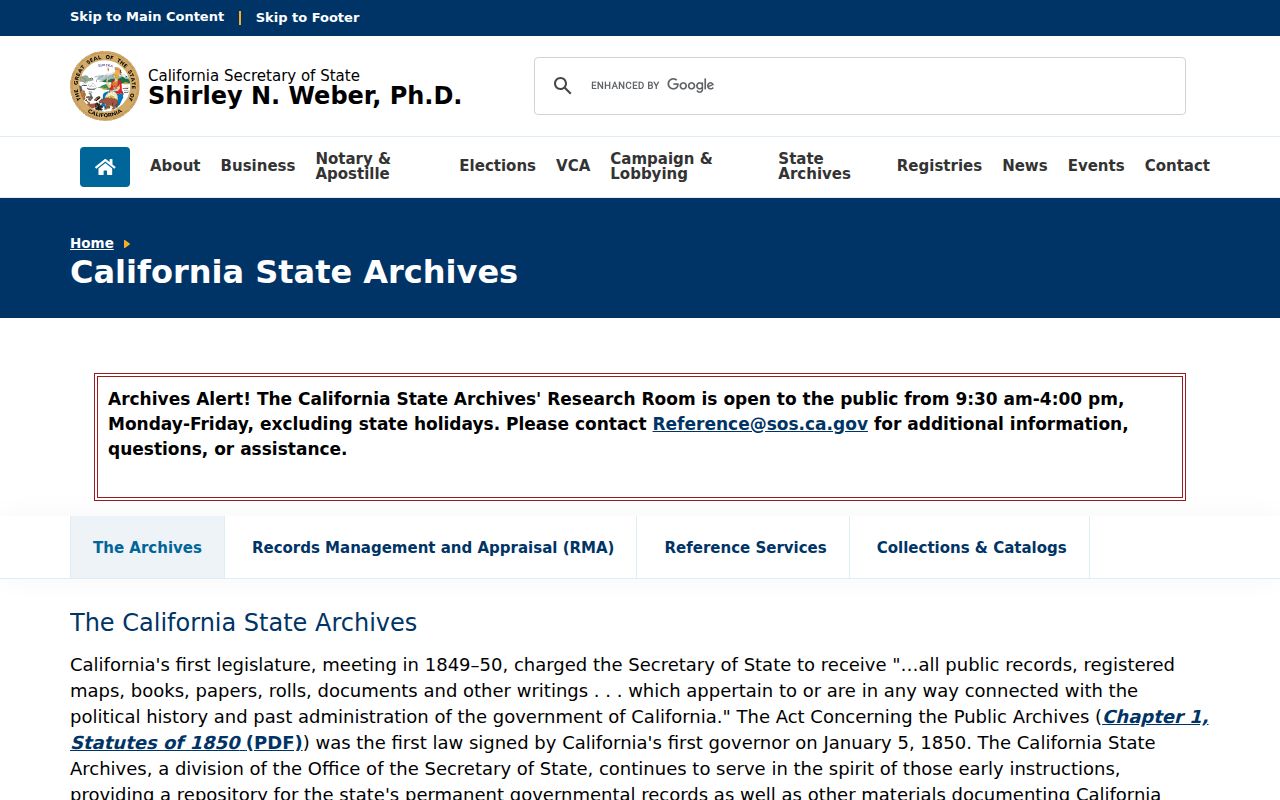
The archive image reinforces the access rule: cataloged history can require a targeted request or onsite work, just as older county deed books do.
The Pleasant Hill Molino Address Story
A local cultural-resource account shows how a Pleasant Hill house history can be built without pretending that one directory is complete. The Molino family rented a 10-acre Pleasant Hill parcel beginning in 1925, planted pears, walnuts, olives, and grapes, and later built a house at 2198 Pleasant Hill Road in 1954. The account joins a family narrative with census material, a probable map owner, subdivision evidence, and the building record.
This is a model for source matching, not a shortcut for every address. The parcel clue points to maps. The map points to a legal or subdivision description. Census and newspapers place people in time. A permit or building source dates construction. A directory can add names and nearby households. When one source is silent, the other sources should remain separate rather than being used to fill the gap by guesswork.
Pleasant Hill Previous Residents and Obituaries
When the library does not conduct an obituary search for a requester, use the licensed database or microfilm yourself, then ask the History Center about its exact search route. The History Center is at 724 Escobar Street in Martinez, open Tuesday through Thursday 9 to 4 and the first and third Saturday 10 to 2. Initial consultation is free; research is $20 per hour for members or $30 for nonmembers, with a one-hour minimum. Fragile maps may need an appointment.
Obituaries and probate can close a previous-residents trail after a family leaves an address. The county library’s microfilm and NewsBank runs supply one route. The History Center obituary search supplies another: surname is required, partial matching is allowed, approximate year is optional, and the date range can be one, two, or five years. Contains is the default match, with Starts With and Exact options. The fee is $5 per name and the normal result is a JPG by email.
Probate cases belong to the Contra Costa Superior Court rather than a city directory shelf. A public case index can identify a decedent or estate matter, but documents and addresses may be restricted or redacted. A death notice, obituary, deed, or probate entry should be compared by date, relatives, parcel, and locality. The goal is to close a historical record trail, not to infer a living person’s current location from an old notice.
Note: An obituary closes a historical trail only when the dates, relatives, and place all agree.
Pleasant Hill Previous Resident Limits
Previous residents research can show a recorded owner, a printed occupant, a census household, or a dated family event. It cannot promise a complete list of people who used an address. Utility customers, DMV addresses, delivery records, confidential voters, and private association rosters are not open substitutes for a missing directory year. A name in an old record may also be stale, misspelled, or tied to a mailing or professional address.
Keep the work tied to family history, house history, genealogy, and lawful personal research. Verify important facts with the custodian that holds the original record, and do not use a historical address to follow, pressure, or expose a living person.
Lawful use. Pleasant Hill previous-resident research is for house history, family history, reconnecting with known people, and civic record work. Public records are not permission to stalk, harass, intimidate, or publish a protected address. California Penal Code sections 646.9 and 422 may apply.